
.png)

High-Functioning Depression: Why Being Productive Doesn't Mean You Are Fine

You met every deadline last week. You packed the school lunches, answered thirty urgent emails before noon, remembered your coworker’s birthday, and kept the household running on time. To your team, your friends, and your family, you look like the gold standard of resilience.
So why do you feel like you are barely surviving inside your own body?
If your life looks put together on paper, but closing your front door at the end of the day feels like collapsing into an empty room, you are not simply “tired from a long week.” You may be living with high-functioning depression—clinically recognized as Persistent Depressive Disorder (PDD) or dysthymia. It is one of the most underdiagnosed conditions in modern medicine, largely because our culture confuses outward productivity with internal peace.
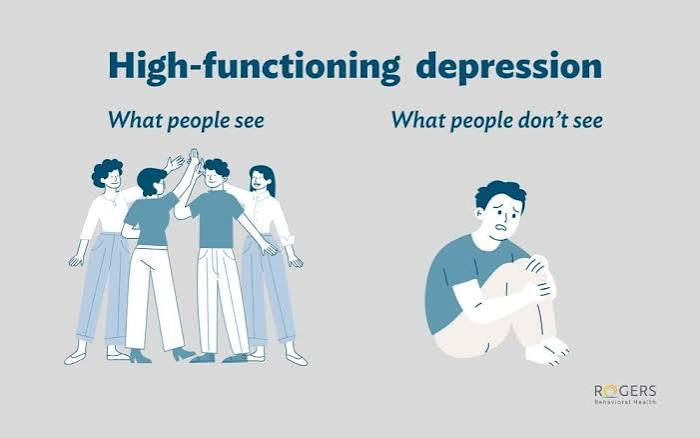
High-Functioning Depression; The Exhausting Game of Pretending
For high-achieving adults, productivity is rarely just a habit; it is often a psychological shield. Staying busy keeps the quiet despair from catching up. The internal logic is automatic: If I keep moving, I am in control. If I let things slip, everything falls apart.
Because you never miss a beat, nobody asks how you are doing. Why would they? You are the dependable one. You hold everything together for everyone else.
Over time, that praise becomes a cage. You feel like an imposter in your own life, trapped by a reputation you are too exhausted to maintain and too terrified to drop.
The Neurobiology Behind the Mask
High-functioning depression is not a character flaw or a lack of gratitude. It is a biological state that reshapes how your brain processes everyday experiences.
Your reward circuits are running dry: In a balanced brain, finishing a hard project triggers a wash of dopamine—a clear biological signal of satisfaction. In high-functioning depression, that reward pathway is blunted. You do not feel proud when you hit a goal; you just feel a dull sense of relief that you survived it, followed by dread for what is next.
Your executive center is working double shifts: Your prefrontal cortex is forced to expend massive metabolic energy continuously holding back internal emotional exhaustion. By 5:00 PM, your brain has burned through its cognitive fuel just keeping up appearances.
Your body is holding onto chronic inflammation: That persistent heaviness in your shoulders, the tension in your jaw, and the subtle, low-grade physical ache you can’t stretch away are physiological markers of chronic, unaddressed stress hormones wearing down your system.
What the Collapse Looks Like at Home
Because every ounce of your energy goes toward your public responsibilities, there is nothing left for the people you love—or for yourself.
Do any of these feel uncomfortably familiar?
The silent commute home: Turning off the car radio because even music feels like too much sensory input.
The weekend paralysis: Spending Saturdays on the couch, staring at your phone, feeling guilty about everything you "should" be doing, yet unable to move.
Snapping at the people closest to you: Losing your temper over a spilled glass of water or a misplaced backpack because your emotional reserves are already at zero.
Going through the motions: Hugging your partner or reading to your child while feeling completely detached, like an actor reading lines from a script.
You Don't Have to Crash to Deserve Support
The most dangerous trap of high-functioning depression is the voice that tells you: "Other people have it worse. I have a good job, a home, and a family. I should just pull myself together."
You do not need to lose your job, end up in the emergency room, or experience a public breakdown for your pain to count. Suffering in silence while doing a great job is still suffering. In fact, running on empty for years reshapes your neural pathways, making recovery harder the longer you wait.
Three Ways to Lower the Pressure Today
Drop one non-essential responsibility: Let the laundry sit unfolded in the basket, or order takeout tonight. Intentionally teach your nervous system that taking a break does not cause a disaster.
Tell one person the truth: The next time a close friend asks how you are, skip the default "Good, just busy!" Try: "Honestly, I’ve been feeling really disconnected and run-down lately."
Get an objective evaluation: Schedule time with a clinical team that knows how to spot depression in high achievers, looking beyond your resume to check in on your actual well-being.
At Favor Mental Health, we see high-achieving professionals, parents, and leaders every day who are exhausted from holding the world on their shoulders. With over 17 years of clinical healthcare expertise, our Bel Air team provides thorough psychiatric evaluations, evidence-based therapy, and thoughtful medication management when helpful. You don't have to carry this alone. Let’s help you get back to feeling like yourself again.
At Favor Mental Health, we provide comprehensive mental health evaluations, individualized treatment plans, psychotherapy, and medication management when clinically indicated.
📍 Favor Mental Health
Suite 9B, 260 Gateway Drive, Bel Air, MD 21014
📞 410-403-3299
If you or your family are experiencing mental health concerns, early support can make a meaningful difference.


Comments